With Nintendo out of the way it's time to look at Sony and what they brought to the table for E3 2017. At last year's show, Sony redefined how E3 press conferences should be performed with a classy presentation that had little to no down time. An opening live orchestral performance that led into the world premier of the new God of War game set the mood and the lack of company execs and developers giving idle pleasantries kept the audience energy at a constant high as game after game after game was shown off. In addition to God of War other titles such as Resident Evil VII and Insomniac Games' new Spider Man were revealed. A handful of brand new IP's even premiered in the forms of Days Gone, Detroit: Become Human, and Hideo Kojima's much anticipated project Death Stranding. This all culminated in one of the most well received press conferences in E3 history and Sony aimed to replicate that success by using the same conference format for 2017. The difference: not nearly as many new titles announced and not a single new IP beyond small VR games. However, as we saw with Nintendo a lack of new announcements doesn't necessarily make for a bad conference but what we will see is that it certainly won't reach the same high as last year's did.
Sunday, June 25, 2017

Sunday, June 18, 2017
E3 2017 Roundup: Nintendo

Thursday, June 8, 2017
Sympathy & Empathy [VIDEO!!]
So I follow a handful of game and anime journalist groups on the web and I've always admired the polish and professionalism these outlets put into their video content. When Memorial Day weekend rolled around I thought, "Screw it. I've got a three day weekend, let's try turning one of my blog posts into a video." Now you can skip the rest of this post and go straight to the video if you want but I want to use this space to talk about the process and my experience while making my first video ever.
Truthfully I would have rather turned one of my video game articles into a video but that would have required me capturing game footage and I have no way to do that without going out and buying a peripheral. So I decided to do one of my anime pieces instead since I could relatively easily acquire video clips for those. From there it was a matter of deciding which anime article to use. In the end I settled on my "Sympathy & Empathy" article because it is the one that I feel most proud about and is also one of my most received pieces. I would later come to realize that I was biting of a little more than I could chew by choosing this piece.
Truthfully I would have rather turned one of my video game articles into a video but that would have required me capturing game footage and I have no way to do that without going out and buying a peripheral. So I decided to do one of my anime pieces instead since I could relatively easily acquire video clips for those. From there it was a matter of deciding which anime article to use. In the end I settled on my "Sympathy & Empathy" article because it is the one that I feel most proud about and is also one of my most received pieces. I would later come to realize that I was biting of a little more than I could chew by choosing this piece.
Tuesday, May 9, 2017
Simple Lessons on Life
"A broken tool is of no use to its owner."
"A weapon doesn't need to think, just destroy."
"Stop pretending to be human and just do what you're told."
 Chances are if you've watched your fair share of anime you've heard lines similar to these in one show or another. They're typically spoken by villains or high ranking military officials to an individual with immense power that comes in a humanoid form of some sort. Human weapon stories come in many shapes and forms such as the usual android tales or characters literally turning into weapons, to give a couple examples. Often times these stories are used to explore the facets that make us human and posit concepts that make the viewer question those established concepts. Along the way you have lines such as the ones above spoken and the protagonist clinging to the human weapon (who is normally in the form of a girl) as he desperately explains the importance of life with tears in his eyes. If you want a example hot off the press look no further than this season's Alice and Zouroku. While offering fresh new characters, such as an old man protagonist, Alice and Zouroku has still followed the tried and true formula of human weapon stories thus far. Human weapon stories have stayed relevant over the years by focusing more on their mysteries of how the human weapons came to be in their respective universes, but the core formula for each has remained the same and it's hard not to say the genre has become stagnant and predictable as a result. It is upon this stage that WorldEnd: What do you do at the end of the world? Are you busy? Will you save us? (sic) has come into play and it aims, from what it has shown so far, to redefine just how a human weapon story is told.
"A weapon doesn't need to think, just destroy."
"Stop pretending to be human and just do what you're told."
 Chances are if you've watched your fair share of anime you've heard lines similar to these in one show or another. They're typically spoken by villains or high ranking military officials to an individual with immense power that comes in a humanoid form of some sort. Human weapon stories come in many shapes and forms such as the usual android tales or characters literally turning into weapons, to give a couple examples. Often times these stories are used to explore the facets that make us human and posit concepts that make the viewer question those established concepts. Along the way you have lines such as the ones above spoken and the protagonist clinging to the human weapon (who is normally in the form of a girl) as he desperately explains the importance of life with tears in his eyes. If you want a example hot off the press look no further than this season's Alice and Zouroku. While offering fresh new characters, such as an old man protagonist, Alice and Zouroku has still followed the tried and true formula of human weapon stories thus far. Human weapon stories have stayed relevant over the years by focusing more on their mysteries of how the human weapons came to be in their respective universes, but the core formula for each has remained the same and it's hard not to say the genre has become stagnant and predictable as a result. It is upon this stage that WorldEnd: What do you do at the end of the world? Are you busy? Will you save us? (sic) has come into play and it aims, from what it has shown so far, to redefine just how a human weapon story is told.
Saturday, April 29, 2017
Step-by-step, turn-by-turn
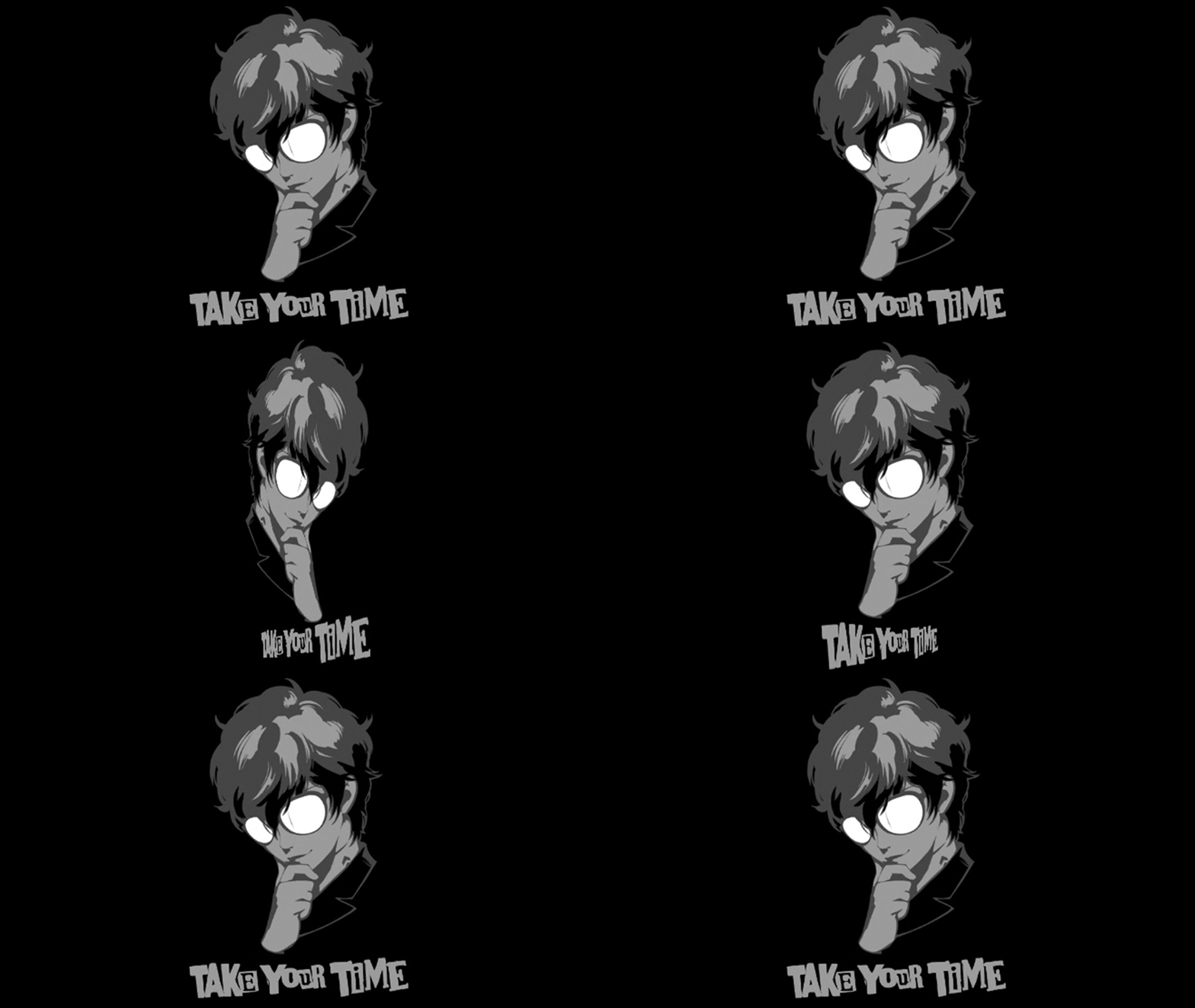 When you boot up any video game one of the first things you will most likely see is a loading screen of some sort. They come in various shapes and forms such as screens that display helpful tips or having some quirky interactive element to kill time. One of Persona 5's loading screens is a simple portrait of the protagonist with the words "Take Your Time" below. It's the only loading screen I can think of that shows a central motif of a game. The idea of "taking your time" permeates the entirety of Persona 5's experience from the way it methodically tells its story, to the way you slowly build relationships with characters, to the meticulous infiltration of Palaces. Of course, the sentiment extends to the game's turn-based combat as well.
By definition a turn-based combat system in a well balanced game requires the player to carefully contemplate their decisions to achieve victory over their enemies. Turn-based combat systems were prevalent on home consoles up through the end of the PS2 generation. Big-name, AAA companies like Square Enix, Bandai Namco, Atlus, and many others put out game after game that utilized turn-based combat. Upon entering the HD era of gaming, however, there was a paradigm shift in how games were presented. Developers wanted to utilize the greatly enhanced graphics to provide players with more grandiose, cinematic experiences and the stop-go nature of turn-based combat limited that ability to do so. As a result the game industry started to see less and less turn-based combat games on home consoles from AAA developers. Instead, active time elements became more prevalent as developers sought systems to keep players more involved in battles and lessen the disconnect felt from definitive turns. As a result, true turn based combat systems found a new home on handheld systems where there is less emphasis on creating dazzling set pieces (although the Switch may change this notion in the future). Series such as Bravely Default found a solid foothold on the 3DS while the long-running Final Fantasy franchise turned full action RPG on home consoles with Final Fantasy XV. The only console games to have come out in recent years from a AAA developer that features a true turn-based combat system are Tokyo Mirage Session #FE, Paper Mario: Color Splash and now Persona 5. While TMS#FE and Paper Mario were fine games on their own rights the combat didn't have that console quality spark to it; the aspect that made them feel at home on a console rather than a handheld. Persona 5, on the other hand, does. It plants its foot firmly on the ground and declares loudly, "I am a turn-based RPG and I deserve to be on consoles." Something about Persona 5's combat gives it that cinematic quality that console games seek and what that something is is what I want to discuss in this piece.
Sunday, April 23, 2017
Kizumonogatari: Repainting a Picture

The Monogatari (the Japanese word for "story") series is a long running light novel series written by Nisioisin and has been made into multiple anime throughout the years, the first of which was Bakemonogatari (Ghostory) which aired back in 2009. Animated by the creative minds of Shaft, all of the Monogatari anime sport the avante-garde animation style and story telling methods that have become synonymous with the studio. The "story" of Monogatari follows high-schooler Koyomi Araragi, a human who has recently reverted back from being a vampire, although he still retains his vampiric regenerative powers. Koyomi has encounters with various "apparitions" that have various effects on those around him such as robbing a girl of her weight, both literally and figuratively, or causing someone to remain forever lost and never reach their destination.
While each season told compelling stories with interesting characters, mind bending dialogue, and eye catching visuals, the origin story to it all, how Koyomi became a vampire in the first place and then reverted back, was never shown in animated form until recently. Eight years after Bakemonogatari first premiered on Japanese television, that origin story, Kizumonogatari (Wound Story) finally saw its conclusion in theaters. By this point a total of 86 episodes spanning across multiple seasons had aired of the Monogatari series. Assuming an average episode length of 25 minutes, that's nearly 36 hours of story. Kizumonogatari, by contrast, was split into a 3-part movie series with each part being 65-90mins in length. While prequels and origin stories are meant to give the viewer new insight into the story and world they already know, it's hard to imagine how much a mere 3 1/2 hours could effect perception of a 36 hour long beast. As it turns out, quite drastically. Kizumonogatari stands tall as the most provocative prequel for a series I have ever seen and has changed how I view the Monogatari series as a whole in ways I never thought possible.
Thursday, March 30, 2017
REVIEW: Ghost in the Shell

Normally I wouldn't write a review in the traditional sense for something but yesterday I had the privilege of seeing an advanced screening for the new Ghost in the Shell movie ahead of it's official premiere on the 31st. Because of that I feel like I'm obligated to write a formal review for it. To begin this comes from the perspective of someone who has not watched any of the original Ghost in the Shell anime, be that the TV series or movies, and as such means this movie was viewed with a clean slate in my eyes.
Ghost in the Shell takes place in the far future where mechanical enhancements to the human body have become common place around the world. The story follows Major (played by Scarlett Johansson), who's brain was transplanted to a fully mechanized body after a terrorist attack left her original body in a near death state. Major is then enlisted in a government anti-terrorism division where she hunts down a wanted cyber-terrorist by the name of Kuzé. The first of her kind, Ghost in the Shell wastes no time in using Major to to push forward the usual themes of human vs. machine prominent in android driven media. Major questioning her own humanity and existence is to be expected but it's the fact that Ghost in the Shell doesn't really push the envelope in any way beyond that expectation that hurts it. The plot follows a fairly standard structure that can be anticipated from beginning to end and doesn't give anything for the viewer to really think on.
The predictable story is certainly not helped by the subpar acting of Johansson. While trying to put forth a serious demeanor her expression came across as confused instead, almost as if she was in a daze the entire time. This was compounded with the Johansson's stiff speech that sounded as if she was reading straight from a script rather than the flippant, non-nonchalant Major that seemed to have been the aim. While it was clear that Major was supposed to be rather lacking in the emotion department there is a difference between acting without emotions and acting a character without emotions, and Johansson was the former.
Fortunately, Johansson's shortcomings were somewhat made up for by some solid performances from the supporting cast. Pilou Asbaek as Batou was a particular standout. Unlike Major, Batou's aloof personality shined through Asbaek's snappy delivery of lines and movements. His actions outside of fighting were purposeful yet also carried a hint of lethargy that complemented his character well. Takeshi Kitano made up for the rather uninteresting character of Aramaki by executing certain key scenes and lines with finesse that got the viewer riled up.
What failed to get the viewer appropriately riled up, however, were the action sequences. While not necessarily bad they weren't particularly engaging either. Each fight was rather one-sided and didn't carry a sense of risk or urgency. Over-reliance on slow motion and over-exaggerated hit reactions resulted in each strike feeling like a dull thud rather than a resounding blow that one would expect from mechanically enhanced humans. Nonetheless, the fights did serve their purpose of breaking up the story sequences and were enjoyable enough as to not be unwelcome when they did come.
Regardless of the characters' portrayals and combat prowess, one thing that can be said is that Paramount Pictures has crafted a rather fitting world for them to reside in. The technopolis setting brims with hologram advertisements and is filled with pedestrians with variety of visually interesting mechanical enhancements. Special effects involving said enhancements were particularly impressive with body parts coming on and off as easily as puzzle pieces or muscle sinew being overlaid on Major with a gel like substance. Light filtering through mesh gratings and reflecting off of all manner of metallic surfaces dazzles the eyes and the hustle and bustle make the city come alive. It all carries a dirty and greasy vibe which perfectly conveys the feeling of technology pervading all aspects of society.
Ghost in the Shell is the very definition of a safe movie. It sticks to well established methods in order to appeal to a more general audience but lost any potential to be memorable in the process. A lackluster story, flat protagonist, and merely serviceable action sequences won't be making any waves but very little about the feature can be legitimately labeled as "bad". By the time the credits rolled I felt next to nothing. I didn't feel disappointed. I didn't feel like I had wasted my time. It almost felt as if I had just sat in a seat and spaced out for two hours. Ghost in the Shell is a forgettable experience that simply fails to leave any sort of lasting impression, good or bad.
Ghost in the Shell
6/10
OK
Subscribe to:
Posts (Atom)